Climate, Finance and History: UZH Historian Delivers Keynote in Canberra
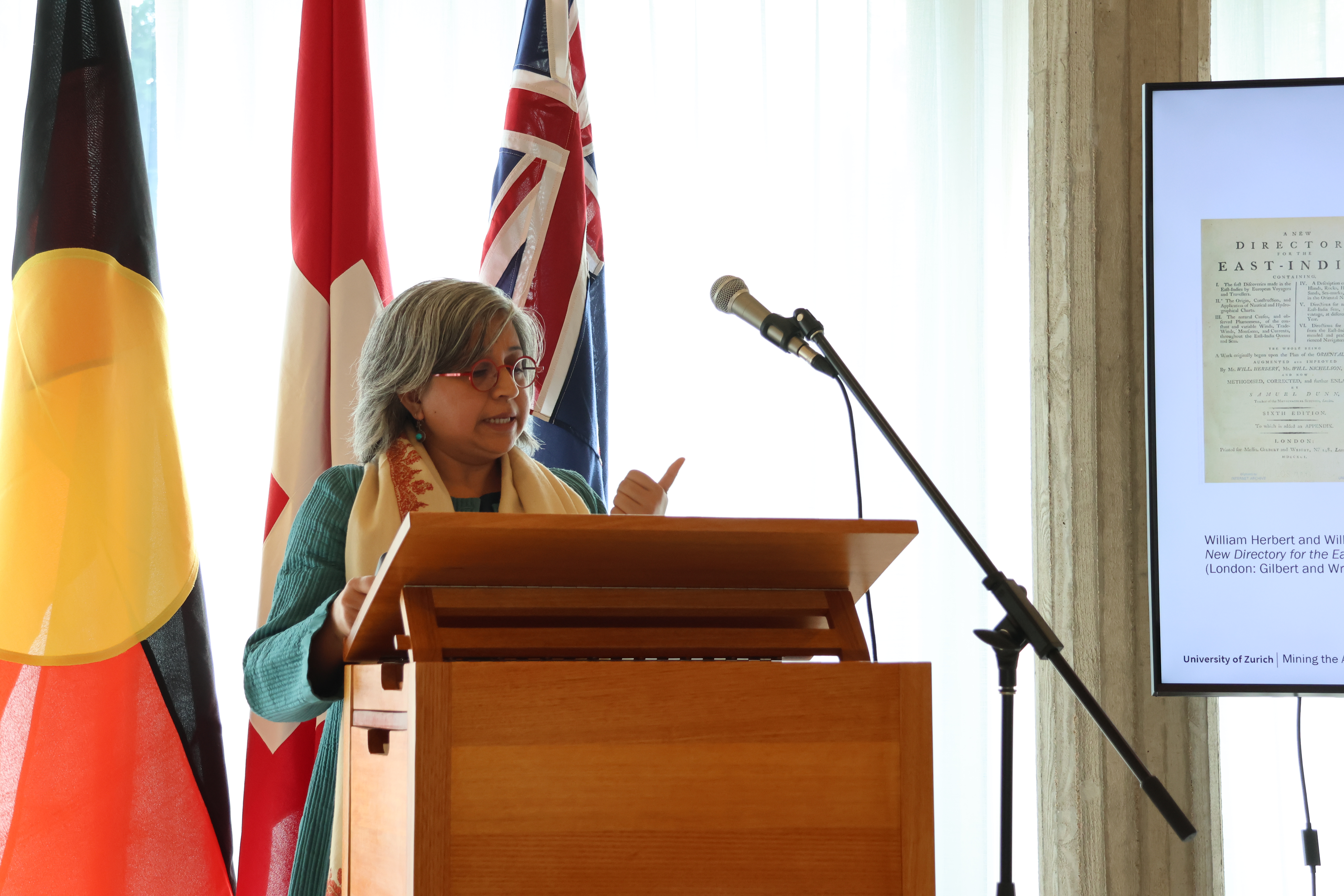
Researchers, policymakers, innovators and diplomats gathered at the Swiss Embassy in Canberra to discuss how historical perspectives, climate risk, sustainable finance, and innovation can contribute to addressing environmental challenges and strengthening resilience. The breakfast event on “Climate and Finance in a Turbulent World: COP31 and beyond” was opened with remarks by Ambassador Barbara Anna Gonzenbach, before Professor Debjani Bhattacharyya, Chair for the History of the Anthropocene at the University of Zurich (UZH), delivered the keynote address, offering a historical perspective on the relationship between climate change, finance and governance.
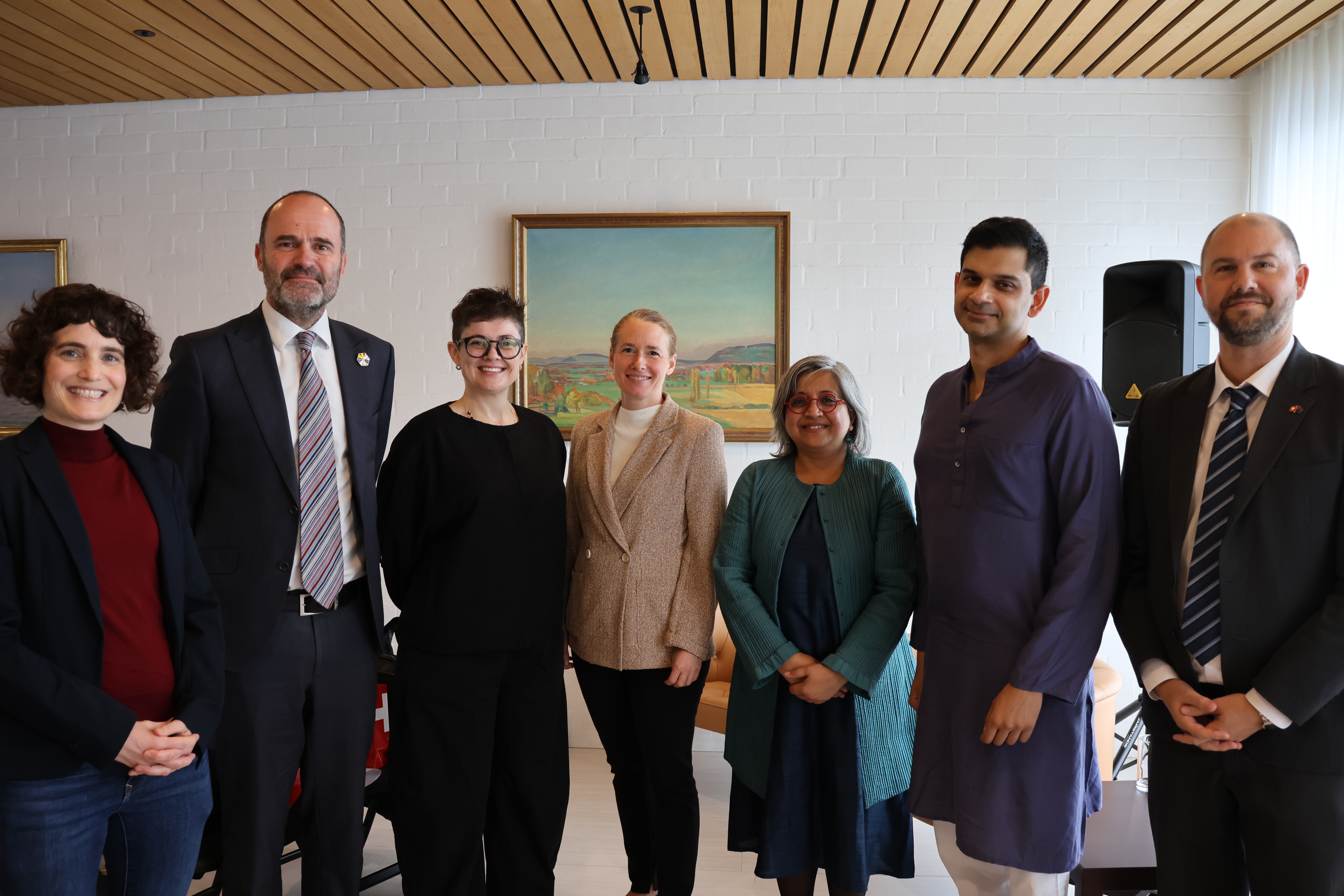
As climate change increasingly shapes political and economic decision-making, discussions often focus on emissions targets, emerging technologies, and financial mechanisms designed to support the transition to a more sustainable future. Professor Bhattacharyya argued that understanding today’s climate debates also requires a longer historical perspective.
During her keynote speech, the historian explained how climate risk and financial risk have evolved together over the last two centuries. She traced how carbon has moved from being primarily a scientific concept to becoming a central concern in policy, finance and international governance.
Drawing on her European Research Council (ERC)-funded project Fair-Weather Finance, Professor Bhattacharyya explored how fossil-fuel extraction, climate science, insurance and financial risk management became closely intertwined over the past two centuries. By studying sources ranging from colonial trade records to insurance archives, the project investigates how historical approaches to environmental uncertainty continue to shape way societies understand and respond to climate risk today.
Her historical analysis also highlighted that climate change cannot be understood solely as an environmental challenge but also as a social and economic one. She argued that historical perspectives can help explain how current systems emerged and why questions of inequality, govern-ance, and justice remain central to climate transitions today.
The keynote served as a starting point for broader discussions on how historical perspectives, technological innovation and sustainable finance can jointly contribute to addressing climate risk. Participants also heard a lightning talk on climate mapping technology and joined a panel discussion exploring how innovation and sustainable finance can help reduce societal risk and help build more resilient societies.
Strengthening UZH's collaboration with Australia
The keynote also reflects UZH's broader engagement with Australia, one of Switzerland's leading partners in research and innovation. UZH fosters collaboration with Australian institutions through its strategic partnership with the University of Queensland, its joint membership with several Australian universities in the global university network Universitas 21, and its role as the Swiss Leading House Asia Pacific, mandated by the State Secretariat for Education, Research and Innovation (SERI). The inclusion of Australia in the current Leading House mandate further strengthens these collaborations and creates new opportunities for scientific exchange between Swiss and Australian researchers.
Learning from Australian expertise
The keynote formed part of Professor Bhattacharyya's broader research visit to Australia. She is currently a Visiting Fellow at the Research School of Social Sciences (RSSS) at the Australian National University (ANU), where she is exchanging ideas with Australian researchers working on environmental change, climate adaptation and resilience.
Reflecting on her experience, Professor Bhattacharyya emphasized the importance of learning from Australian expertise:
"As Europe heats up the way it is currently, we have a lot to learn from our colleagues in Australia who have made excellent strides in studying the compounding effects of the climate crisis."
Rather than viewing climate change as an isolated environmental challenge, Professor Bhattacharyya describes it as a "polycrisis" – a set of interconnected environmental, economic and social challenges that reinforce one another.
“The ecological fallout from the polycrisis is leaving us with deep social and economic inequalities across the world. Australia is a continent regularly swept by hurricanes, cyclones and forest fires and there is deep knowledge and expertise in these fields, not only in the natural sciences, but also among historians, sociologists and economists.”
Looking beyond the event itself, Professor Bhattacharyya also sees considerable potential for future collaboration between UZH and Australian partners:
"What has been fruitful about my time here are the possible collaborations I can foresee between UZH and ANU. If we understand heat and drought as more than climatological issues, as issues of economic and social justice, then as scholars we need to join forces to define and then tackle the multivalent nature of climate risk.”