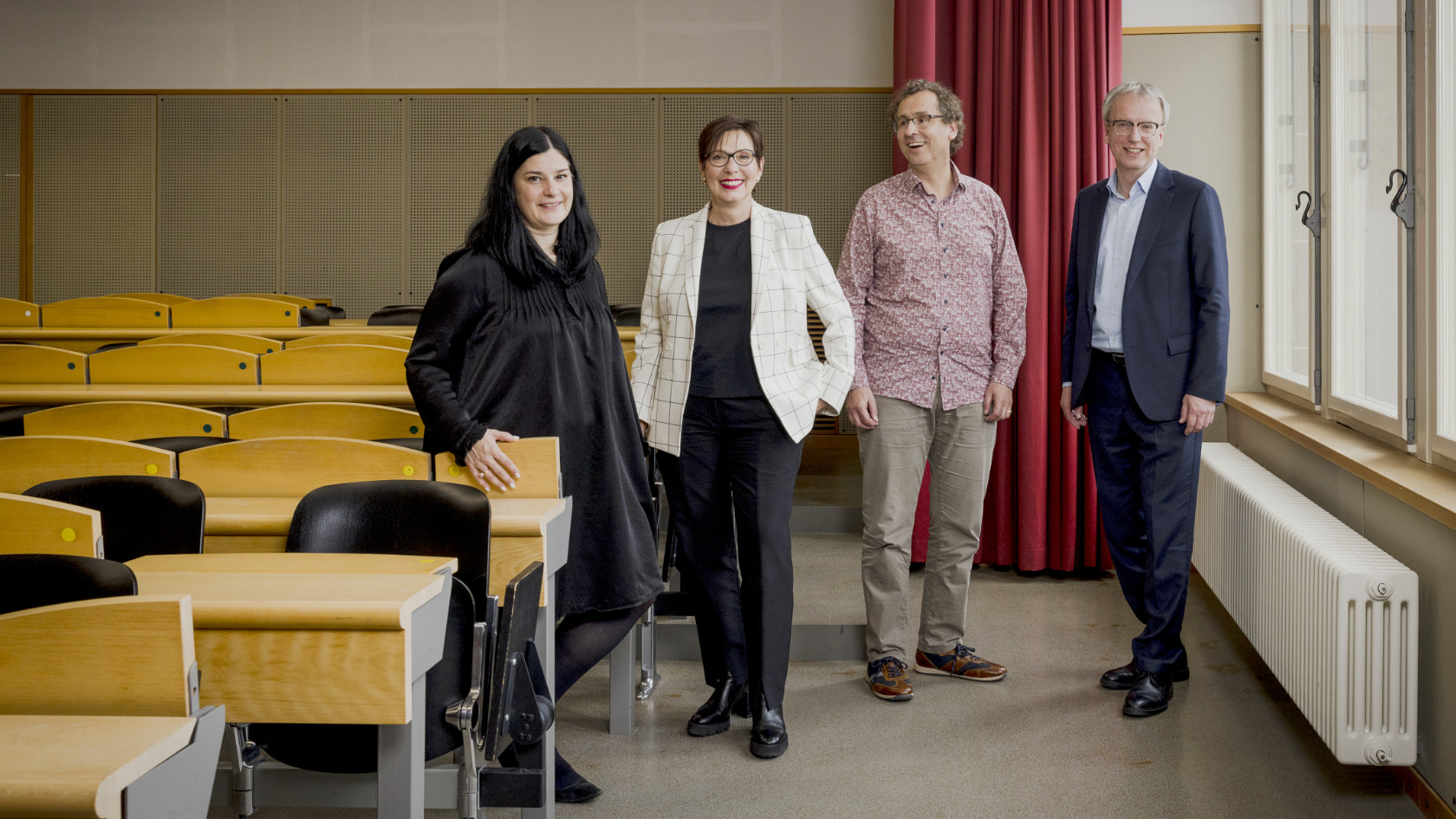
Una Europa Testimonial: Natalia Werner and Annika Silberstein-Loeb
-
 Annika Silberstein-Loeb (left) and Natalia Werner (right) work in the Educational Development Office, where they coordinate Una Europa education initiatives. Working at the intersection of teaching and learning development and internationalisation, they support the design, development, and coordination of collaborative educational opportunities across the Una Europa alliance.
 -
 During the Staff Week in Helsinki in June 2026, Natalia gained valuable insights into students’ perspectives, which was particularly relevant to her role at the interface between students, academic staff, and professional staff.
 -
 Over the course of her involvement with Una Europa, Annika attended five General Assemblies, with her final one taking place in Paris in May 2026.
You both work in the Educational Development Office at the UZH, where you coordinate Una Europa education initiatives and are part of the Teaching and Learning Cluster. Could you briefly explain what you do there and what your roles involve?
Natalia: At UZH, we coordinate the university’s involvement in Una Europa’s teaching and learning activities. This includes working with colleagues across faculties and partner universities to develop and implement international learning opportunities for students and staff.
Annika: I think what we do is help translate the strategic goals of the university into concrete educational activities at the operational level. At UZH, the Global Strategy 2030 states that all students should have the opportunity to gain a significant international experience as part of their degree program. Our work contributes to making this possible for example by developing concrete formats that allow students to gain valuable international experience, even without leaving their home university.
One of the projects you coordinate is the Una Europa DSAI Module Exchange, which is led by UZH. Could you tell us more about this initiative?
Natalia: TheDSAI Module Exchange is a virtual exchange program that allows students from select Master’s programs to take online courses in Data Science and Artificial Intelligence at various Una Europa partner universities. The courses are fully online, and the credits are recognized as part of the students’ degree. At the moment, four universities are participating in the program, together offering 15 different modules for students to choose from.
Annika: I think what is most valuable about this program is that it offers students what we framed as a “stay at home and study abroad” opportunity. It is a complementary format to the regular exchange semester. It allows students to access new perspectives and take courses they might not have at their own university, all while staying at home. In that sense, it is very much aligned with the broader vision of Una Europa, which is about offering transnational education and creating meaningful international learning opportunities in different formats. Not every student can go abroad for a full semester, so it is important to find other ways of connecting students, universities, and perspectives across borders.
What has your experience been in coordinating the DSAI Module Exchange? What has been rewarding, and what has been challenging?
Annika: I think coordinating it has been super rewarding and also a lot of fun. We work with many partners from different institutions who really see the value of offering this kind of program to students, which has been very motivating.
At the same time, I think we also have to admit that it is much more complex than it might appear from the outside. From a student’s perspective, the format seems quite straightforward: you choose an online course, take it at a partner university, and then the credits are recognized in your curriculum or transcript of records. But behind the scenes, it involves a lot of alignment between different institutional contexts, academic calendars, regulations, and expectations across the Una Europa partner universities. Even something that sounds simple, like academic calendars, can become quite complex, for example when exam periods at one university overlap with semester breaks at another. So there are quite a few challenges involved.
Natalia: One challenge that I personally still find difficult is that, at the moment, the Module Exchange is only open to a very small group of students from selected Master’s programs. There is a lot of interest from students in different faculties who would also like to participate, but right now we cannot offer it to everyone. Sometimes saying no to students is personally difficult for me, especially because we see the huge potential of this format and would like to expand it to more faculties and students.
Natalia, you recently returned from the Una Europa Staff Week in Helsinki, which focused on the topic of universities as transformative learning communities for all. What stood out to you most from that experience?
Natalia: What made the Una Europa Staff Week in Helsinki very special for me was that students were involved. That was especially valuable because I work at the interface between students, academic staff, and professional staff. It gave me valuable insights into students’ perspectives and into the challenges they face. One of the issues that came up repeatedly was that students still struggle with highly hierarchical institutional structures, which can sometimes limit their participation and co-creation.
Another thing I really liked about the Staff Week was the innovative, workshop-driven approach. We did not just passively listen to presentations. Instead, we were encouraged to actively engage, reflect, and co-create together with colleagues from different universities.
Annika, after several years with Una Europa, you will be leaving Una Europa and UZH at the end of the summer. You also recently attended your final General Assembly in Paris. Looking back, what stands out most to you?
Annika: That is a big question. Maybe I’ll start with the final General Assembly. Meeting many colleagues there, knowing that it would be the last time in person for now, made me realize how dedicated we have all been over the past four years. So many people are involved in Una Europa and really stand behind its goals.
It was also a moment to look back and see the success stories that have developed over these years. I feel very fortunate that I was able to work with all these people and to experience the diversity of universities in Europe. As higher education institutions, we share a similar mission, but at the same time, we all work so differently. The size of the institutions, the structures, the ways of doing things, there is so much diversity.
What I take with me is a strong connection to the overall idea of Una Europa: strengthening international collaboration in higher education and creating opportunities for students to engage across borders. It is about allowing students not only to study at one university, but also to access these experiences in different ways, beyond the classic exchange semester.
Especially in times of geopolitical uncertainty and conflict, I think it is very valuable to have something that brings people together and fosters these connections. For Switzerland, being eligible to be part of the European Universities Initiative has been particularly relevant, as Una Europa has allowed us to stay closely connected to developments in the European higher education context and to remain in close exchange with our partners.
What has been one of your personal highlights of working with the Una Europa alliance?
Natalia: For me, I am lucky enough to have three highlights, and I'd like to mention all of them. One was definitely the Staff Week in Helsinki. It was a great experience for me. I loved the workshops, the opportunity to exchange ideas, and the chance to get to know so many people. Another highlight has been getting to know the people behind Una Europa, both at the UZH and internationally. I really enjoy the international aspect of my job.
But the absolute highlight for me was working with Annika. I benefited enormously from her knowledge of the DSAI Module Exchange and from her experience of setting it up. This whole Module Exchange happened thanks to Annika, and I was able to profit greatly from her knowledge and continue working with this format. On both a professional and personal level, she has always been very supportive and approachable. I’m really sad to see her leave, but I wish her all the best for this exciting next chapter.
Annika: For me, what I always find extremely rewarding is speaking to individual students and hearing what these opportunities meant for them. Sometimes it is about being able to take a specific course that they would not have had access to at their home university. An example is the UnaVEx project, where students work on sustainability topics with peers from other Una Europa universities and partner universities in Africa. I spoke to some students, and hearing how meaningful these exchanges are, especially when it comes to gaining new perspectives, really shows the impact.
And of course, another highlight has been working with colleagues, both internally at UZH and externally across the alliance. It is really the people you work with. I am looking forward to seeing the alliance continue to grow and to seeing more achievements and opportunities for students.